
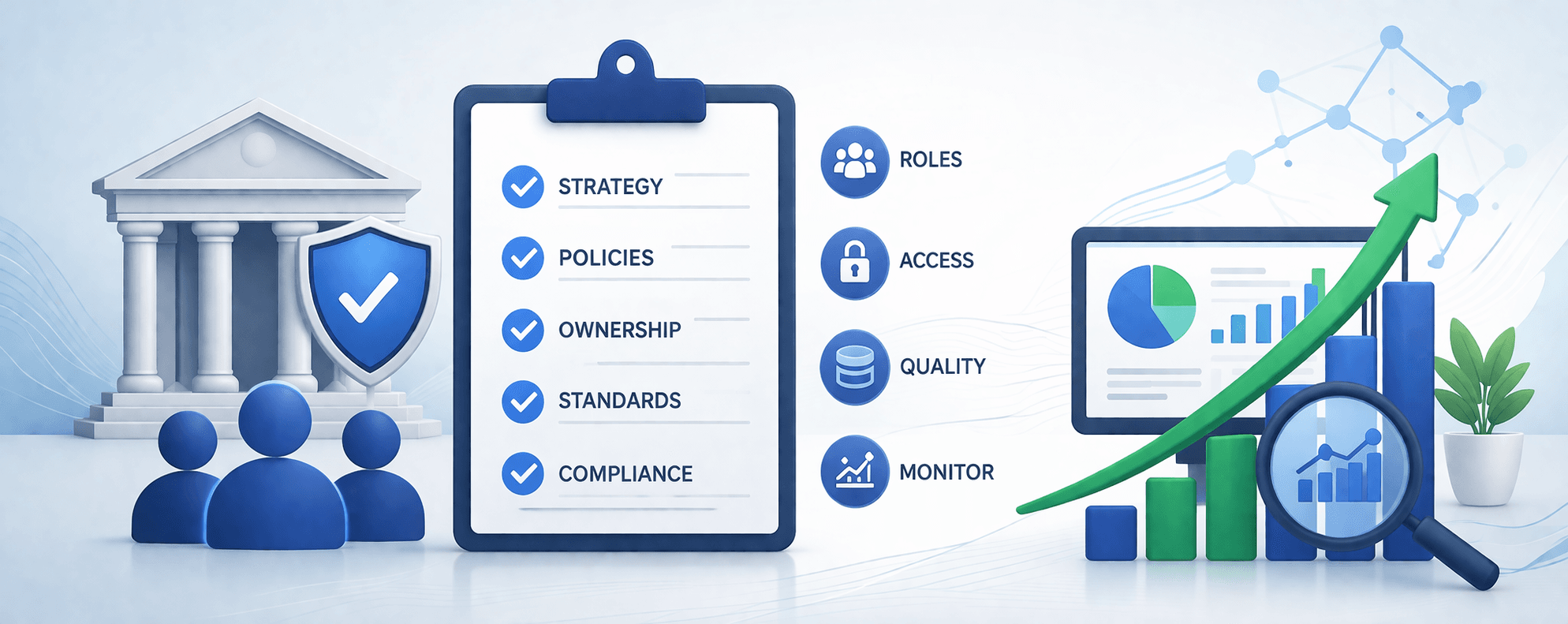
Every growing business reaches a point where data chaos starts slowing decisions, compliance risks increase, and teams lose trust in reports. That’s where governance strategy & policy design becomes a business-critical capability.
A well-defined governance model helps organizations create clear ownership, improve data quality, enforce security, and align policies with business goals. Modern governance frameworks now focus on agility, accountability, metadata, access control, and AI readiness.
Industry best practices consistently emphasize roles, standards, KPIs, compliance, and business alignment as the foundation of strong governance.
In this guide, you’ll learn how to design an effective governance strategy, create scalable policies, and implement a framework that supports long-term growth.
What Is Governance Strategy & Policy Design?
Governance strategy & policy design is the structured process of defining how data, systems, processes, and business rules are managed across an organization.
It includes:
- Governance vision and objectives
- Policy creation and enforcement
- Data ownership and stewardship
- Security and access rules
- Compliance controls
- Metadata and business glossary standards
- Monitoring KPIs
- Review and continuous improvement
The goal is simple: make data trustworthy, secure, accessible, and business-aligned.
Why Governance Strategy Matters for Modern Enterprises
A strong governance strategy supports:
1) Better Data Quality
Clear policies reduce duplication, inconsistency, and outdated records.
2) Faster Decision-Making
Teams can confidently use governed data for analytics and AI initiatives.
3) Regulatory Compliance
Policies help meet GDPR, HIPAA, CCPA, and industry-specific standards.
4) Stronger Security
Role-based access and classification policies reduce exposure risks.
5) Cross-Functional Alignment
Marketing, finance, HR, and IT all follow one trusted governance model.
Best-practice frameworks highlight ownership, accountability, compliance, adaptability, and KPIs as the pillars of effective governance.
Governance Strategy & Policy Design Framework
A practical governance framework should include the following layers.
1. Business Goals and Governance Vision
Start by aligning governance with measurable outcomes:
- Improve reporting accuracy
- Reduce compliance violations
- Enable AI readiness
- Standardize customer data
- Strengthen data catalog adoption
Pro Tip: Governance should support revenue, risk reduction, and efficiency—not just compliance.
2. Roles, Ownership, and Accountability
Define who owns what.
Key roles include:
- Chief Data Officer (CDO) – executive governance leadership
- Data Owners – business accountability
- Data Stewards – quality and metadata control
- Security Teams – access and privacy enforcement
- IT Teams – systems integration and implementation
Without clear ownership, policy design usually fails.
3. Policy Design Standards
Your governance policies should cover:
- Data classification
- Naming conventions
- Metadata standards
- Retention policies
- Access control
- Privacy requirements
- Quality rules
- Lineage documentation
- Incident escalation workflows
Example Policy Statement
Customer PII can only be accessed by approved finance, compliance, and support users through role-based permissions.
This makes enforcement measurable and auditable.
Best Practices for Governance Policy Design
Here are proven strategies used by modern enterprises.
Start Small, Scale Fast
Begin with one high-impact domain:
- Customer data
- Finance reporting
- Product analytics
- Compliance-sensitive records
Use Business Glossaries
Standard definitions reduce metric conflicts across teams.
Build Policy Lifecycle Reviews
Policies must evolve with:
- New regulations
- New systems
- Mergers
- AI tools
- Data products
Define Governance KPIs
Track measurable outcomes such as:
- Data accuracy %
- Policy adherence %
- Access violation incidents
- Metadata completeness
- Data discovery time
- Audit readiness score
KPIs are repeatedly recommended as a core governance success factor.
Practical Use Cases of Governance Strategy & Policy Design
Enterprise Data Governance
Create standards for master data, metadata, lineage, and access.
AI Governance Readiness
Define ethical AI usage, training data quality, explainability, and compliance rules.
Financial Reporting Governance
Ensure clean reconciled data for quarterly and annual reporting.
Customer 360 Governance
Unify customer identity rules across CRM, support, loyalty, and analytics systems.
Common Challenges in Governance Design
Many organizations struggle with:
- Lack of executive buy-in
- Poor role clarity
- Overly complex policies
- No ownership model
- Manual governance workflows
- Low adoption by business teams
How to Fix It
- Use simple business-first language
- Automate policy checks
- Build stewardship workflows
- Integrate with data catalogs
- Review policies quarterly
- Train teams continuously
Tools That Strengthen Governance Policy Execution
Modern governance strategy works best with:
- Data catalogs
- Metadata management platforms
- Data lineage tools
- Access governance tools
- Quality monitoring systems
- Policy workflow automation
- Compliance dashboards
These tools improve discoverability, stewardship, and enforcement at scale.
Conclusion
A strong governance strategy & policy design framework is no longer optional—it is essential for compliance, AI readiness, trusted analytics, and business scalability.
The most successful organizations treat governance as a living operating model, not a one-time documentation exercise. By combining clear ownership, measurable KPIs, adaptable policies, and the right governance tools, businesses can create a resilient foundation for data-driven growth.
If your organization is planning a data governance consulting initiative, policy modernization, or AI governance framework, now is the right time to start with a scalable strategy.


