
Why Data Strategy Matters More Than Ever
In today’s digital economy, businesses run on data. From customer insights and financial reporting to AI-driven decision-making, data has become one of the most valuable assets an organization owns.
But simply collecting large volumes of data does not create value. What truly matters is how effectively businesses organize, control, and use that data.
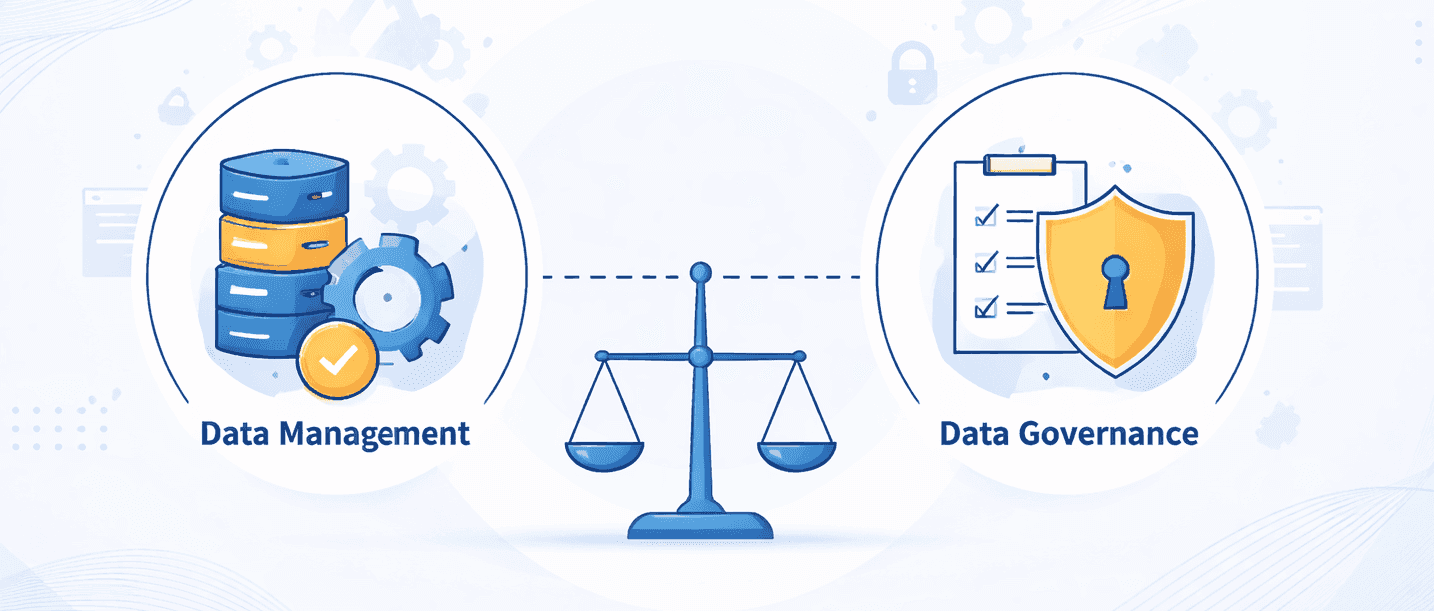
This is where data management and data governance play a critical role.
Many organizations assume these two terms mean the same thing. In reality, they serve different purposes — yet work together to build a strong and reliable data ecosystem.
Understanding the difference between data governance vs data management helps organizations:
- Improve data quality
- Enable reliable analytics
- Maintain regulatory compliance
- Support AI and digital transformation initiatives
In this guide, we’ll explore what each discipline means, how they differ, and why modern businesses need both.
What is Data Management?
Data management refers to the operational and technical processes used to collect, store, organize, and maintain data throughout its lifecycle. It focuses on how data moves through systems and how it is prepared for business use.
A well-defined data management strategy ensures that information is:
- Easily accessible
- Stored efficiently
- Consistent across systems
- Reliable for reporting and analytics
Key Functions of Data Management
Typical data management activities include:
- Collecting data from multiple systems
- Integrating data across platforms
- Transforming and processing datasets
- Managing storage in data warehouses or data lakes
- Monitoring data quality
- Handling data lifecycle stages
Example: Data Management in Practice
Consider an e-commerce business that gathers information from its website, CRM, payment systems, and inventory tools.
Strong data management ensures:
- All customer and transaction data is centralized
- Duplicate records are removed
- Sales data aligns with inventory levels
- Historical records are archived properly
Without effective data management, organizations often face data silos, inconsistent reports, and unreliable insights.
What is Data Governance?
While data management focuses on execution, data governance focuses on control and accountability.
Data governance defines the policies, standards, and responsibilities that determine how data is accessed, protected, and used across the organization.
A strong governance framework ensures data remains:
- Secure
- Accurate
- Compliant with regulations
- Consistent across departments
Key Functions of Data Governance
Common governance responsibilities include:
- Defining data policies and standards
- Assigning data ownership and stewardship
- Ensuring privacy and regulatory compliance
- Setting data quality benchmarks
- Managing metadata and data catalogs
- Monitoring access and usage
Example: Data Governance in Practice
In a healthcare organization, governance policies may ensure:
- Only authorized staff can view patient records
- Sensitive data is encrypted
- Privacy regulations are followed
- Quality standards are consistently maintained
Without governance, organizations risk security breaches, compliance failures, and misuse of sensitive information.
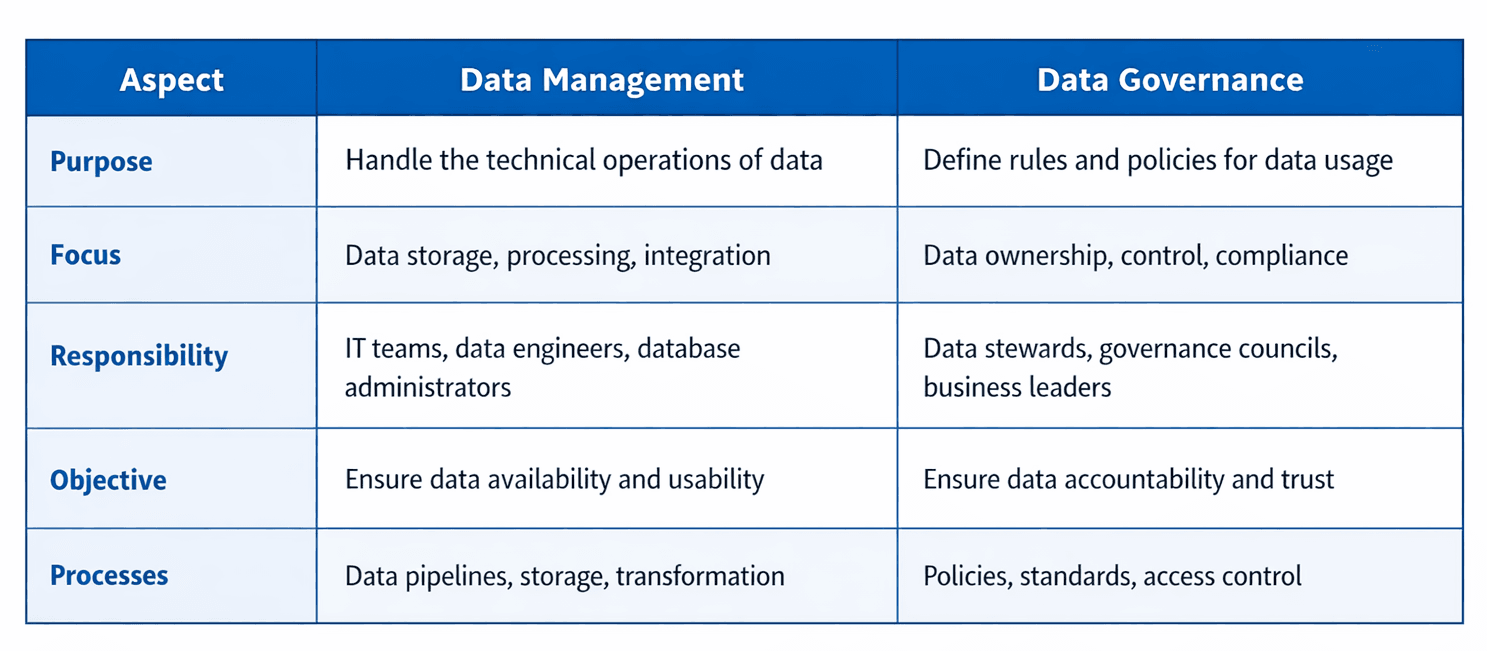
Data Management vs Data Governance: What’s the Difference?
Although both disciplines deal with enterprise data, their focus areas are different.
A Simple Way to Understand
Data Governance = The Rules
Data Management = The Execution
Governance sets expectations, while management ensures those expectations are met within systems.
How Data Governance and Data Management Work Together
These disciplines are not separate initiatives. Instead, they complement each other.
Governance defines:
- Data ownership
- Compliance requirements
- Quality standards
- Security policies
Management implements:
- Data pipelines
- Storage infrastructure
- Integration processes
- Lifecycle management
For example, governance may require customer data accuracy to meet a specific threshold. Data management teams then implement validation and cleansing processes to achieve that goal.
Together, they create trustworthy enterprise data.
Core Components of Data Governance
A successful governance program typically includes:
Data Policies
Clear policies ensure consistency in how data is collected, stored, and shared.
Data Stewardship
Data stewards monitor data accuracy, resolve conflicts, and maintain documentation.
Data Quality Standards
Organizations define measurable benchmarks such as accuracy, completeness, and timeliness.
Compliance and Security
Governance frameworks help businesses meet regulations like GDPR and industry-specific privacy laws.
Core Components of Data Management
Effective data management builds the technical foundation for analytics and operations.
Data Architecture
Defines how data flows through platforms such as data lakes and cloud warehouses.
Data Integration
Combines information from CRM, ERP, and marketing systems to create a unified data view.
Data Storage
Organizations rely on scalable storage technologies including distributed databases and cloud platforms.
Data Lifecycle Management
Data moves through stages like creation, usage, archival, and deletion.
Data Quality Management
Automated tools identify duplicates, missing values, and inconsistencies to maintain reliability.
Emerging Trends in Data Governance and Management (2026)
As organizations become more data-driven, both disciplines continue to evolve.
- AI governance for training data transparency and bias mitigation
- Stricter privacy regulations and consent management requirements
- Data mesh adoption with decentralized ownership models
- Metadata-driven strategies for discovery and lineage tracking
- Automated governance platforms powered by AI
Business Benefits of Strong Data Governance and Management
Organizations that invest in both areas gain significant competitive advantages.
- Faster and more accurate decision-making
- Reduced compliance and legal risks
- Higher data quality and consistency
- Improved analytics and AI performance
- Stronger organizational trust in data
When teams trust their data, innovation and agility naturally increase.
Best Practices for Implementation
To build a successful enterprise data strategy:
- Start with clear business objectives
- Establish a formal governance framework
- Invest in modern cloud-based data architecture
- Implement data catalogs and metadata management
- Automate quality monitoring processes
- Promote a data-driven culture across teams
Treat governance and management as two parts of one strategy, not separate initiatives.
Final Thoughts
Understanding the difference between data management and data governance is essential for organizations aiming to become truly data-driven.
Governance defines the rules and accountability.
Management ensures data is processed, stored, and delivered effectively.
Together, they create a structured, secure, and scalable data ecosystem that supports analytics, AI innovation, compliance, and long-term business growth.
As data volumes continue to grow in 2026 and beyond, companies that invest in both governance frameworks and robust data management practices will be best positioned to unlock real business value.


